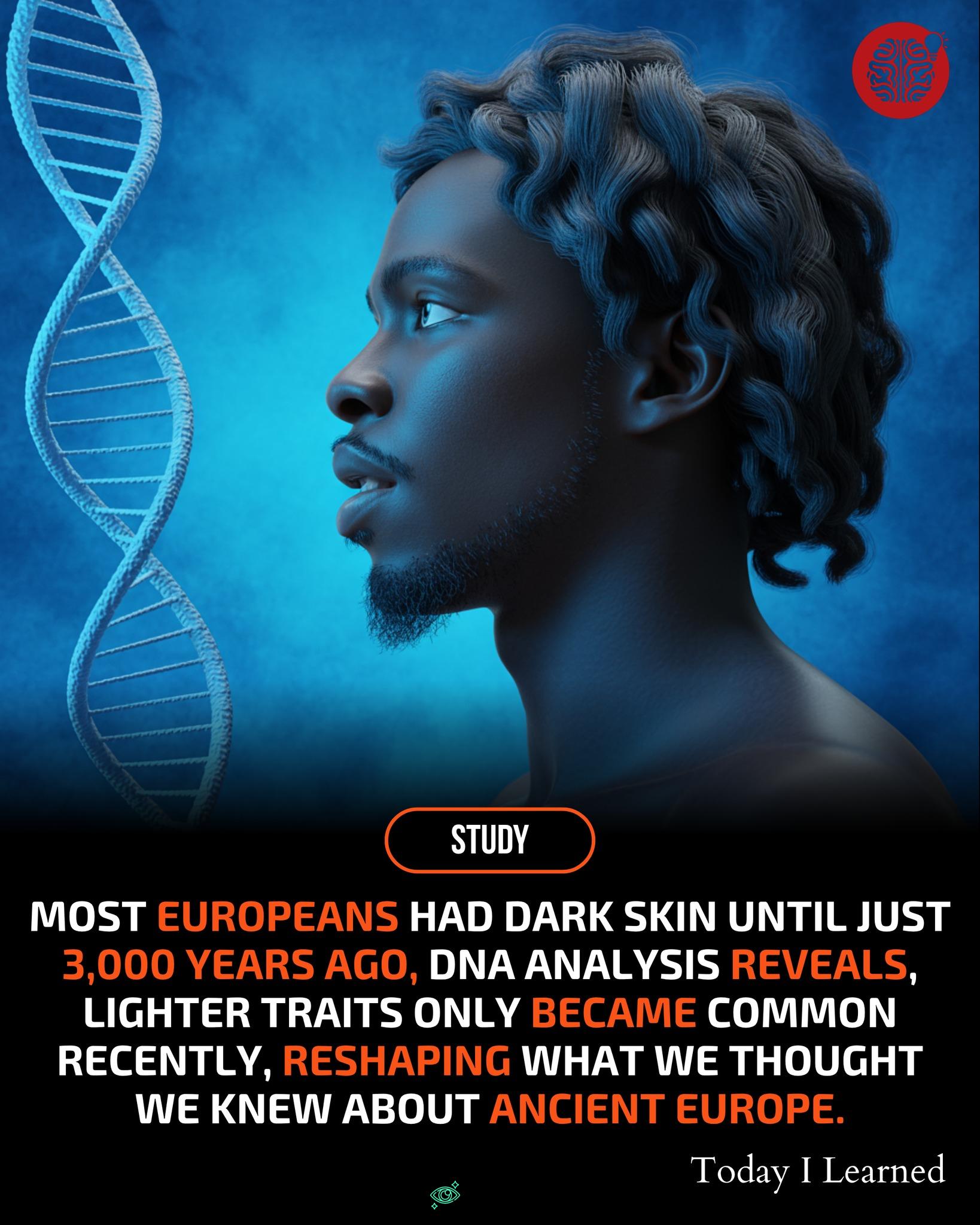
🧬 Most Europeans Had Dark Skin Until Just 3,000 Years Ago New DNA Study Reveals 🌍✨
Think you know what ancient Europeans looked like? Think again.
A groundbreaking DNA analysis has revealed that for most of Europe’s history well into the Iron Age the continent’s population had dark skin, dark hair, and dark eyes. That means the image of pale-skinned Europeans is a relatively modern development, emerging only in the last few thousand years.
The study, which analyzed 348 ancient DNA samples from 34 countries across Europe and Asia, tracked how pigmentation traits evolved over the past 45,000 years. While lighter features first appeared around 14,000 years ago, they remained rare until about 3,000 years ago, when they began to spread more widely.
Why the shift? Scientists believe lighter skin may have offered a survival advantage in northern climates, helping the body better synthesize vitamin D with less sunlight. Traits like light eyes, however, may have spread due to sexual selection or genetic drift not necessity, but preference or chance.
It’s a powerful reminder that human appearance is fluid, shaped by migration, adaptation, and thousands of years of environmental and social change.
So next time you picture ancient Europe, remember: it looked very different than today and DNA is telling us the real story.
🧬 Most Europeans Had Dark Skin Until Just 3,000 Years Ago New DNA Study Reveals 🌍✨
Think you know what ancient Europeans looked like? Think again.
A groundbreaking DNA analysis has revealed that for most of Europe’s history well into the Iron Age the continent’s population had dark skin, dark hair, and dark eyes. That means the image of pale-skinned Europeans is a relatively modern development, emerging only in the last few thousand years.
The study, which analyzed 348 ancient DNA samples from 34 countries across Europe and Asia, tracked how pigmentation traits evolved over the past 45,000 years. While lighter features first appeared around 14,000 years ago, they remained rare until about 3,000 years ago, when they began to spread more widely.
Why the shift? Scientists believe lighter skin may have offered a survival advantage in northern climates, helping the body better synthesize vitamin D with less sunlight. Traits like light eyes, however, may have spread due to sexual selection or genetic drift not necessity, but preference or chance.
It’s a powerful reminder that human appearance is fluid, shaped by migration, adaptation, and thousands of years of environmental and social change.
So next time you picture ancient Europe, remember: it looked very different than today and DNA is telling us the real story.




 LearnGems
 Reel Series
 LIVE CREATOR CENTER
 Visit: Galactic Global Network
 Download Mobile Apps






 English
 Arabic
 French
 Spanish
 Portuguese
 Deutsch
 Turkish
 Dutch
Dutch
 Italiano
 Russian
 Romaian
 Greek
Greek